Policy and Advocacy Newsletter
Since our last newsletter: The policy team has drawn attention to the importance of lifesaving assistance and the brave humanitarians who...
READ FULL STORY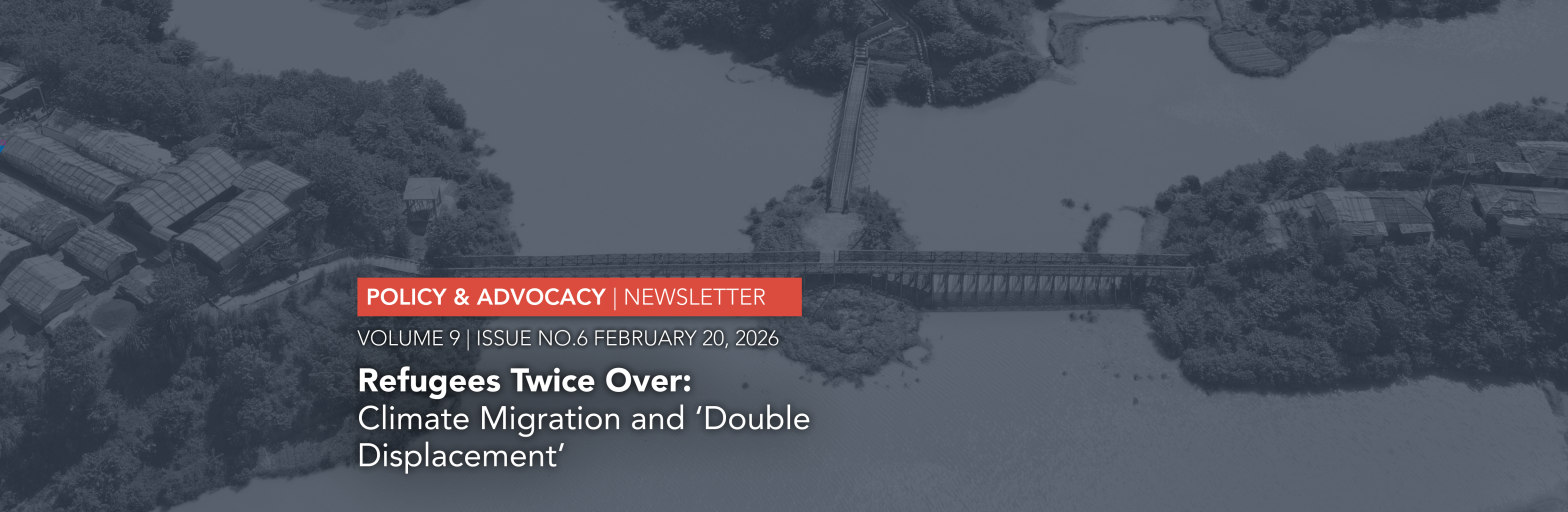
Double displacement occurs when people who have already been uprooted once are forced to flee again. As extreme heat, rising sea levels, and intensifying storms reshape the planet, millions will find themselves displaced multiple times over.
Refugees are among the most vulnerable to climate shocks. By 2050, the United Nations predicts that many refugee camps will become nearly uninhabitable due to climate-related disasters. These camps—designed as temporary shelters—are often located in climate hotspots and lack the infrastructure to withstand extreme weather. In Jordan’s Za’atari camp, 62% of Syrian refugees face high vulnerability to intensifying heat waves, dust storms, and water scarcity, while in Cox’s Bazar, Bangladesh, refugees repeatedly lose their homes to fires, flooding, and landslides.
Yet as climate change threatens the safety of the world’s refugees, pathways out of displacement are becoming harder to find.
To learn more, read the full brief here.
Since our last newsletter, the Policy & Advocacy team underscored the profound human and social costs of family separation, examining both international laws governing family unity and the varied ways U.S. policies are separating children from their parents and caregivers. The team released a From the Archives feature revisiting a powerful conversation of a former USCRI policy analyst with the Dalai Lama, shared a timely situation update on Myanmar (Burma), and explored the growing crisis of “double displacement” affecting communities already uprooted by climate change.
In this month’s newsletter, the Policy & Advocacy team commemorates 100 years of Black History Month by confronting the enduring inequities in migration and forced displacement, and uplifting the bold, community-driven solutions Black leaders are advancing. The newsletter examines the lasting harm immigration enforcement inflicts on children, the troubling curtailment of humanitarian parole authority, critical updates on Temporary Protected Status (TPS), response from the public to Operation PARRIS, and the mounting financial cost of third country deportations, which USCRI has been tracking here.
Globally, we provide urgent updates from the East and Horn of Africa, analyze the return of over 5 million Afghans to Afghanistan from Pakistan and Iran, reflect on conditions five years after the coup in Myanmar, and unpack significant changes to asylum law passed by the European Parliament.
Had this email forwarded? Sign-up here to get it in your inbox directly.


Since our last newsletter: The policy team has drawn attention to the importance of lifesaving assistance and the brave humanitarians who...
READ FULL STORY
Since our last newsletter: The policy team has updated our Third Country Deportations tracker, published an overview of Afghan refugee...
READ FULL STORY
In the weeks following the end of July 2026, the media has been flooded with pictures and videos of tens of thousands...
READ FULL STORY