Policy and Advocacy Newsletter
Since our last newsletter: The policy team has updated our Third Country Deportations tracker, published an overview of Afghan refugee...
READ FULL STORY
Since our last newsletter: The policy team has drawn attention to the importance of lifesaving assistance and the brave humanitarians who provide it on World Humanitarian Day, and lifted up the story of a former refugee and human rights advocate Yasin Arfat on Rohingya Genocide Remembrance Day. We also published a new From the Archives piece reflecting on how decades of photographs taken by USCRI analysts capture not only the suffering of displacement, but the courage and resilience of refugees themselves. Also, don’t miss Associate Director of Humanitarian Legal Services Sara Lowrey’s reflections on America’s unfinished promise to Afghans, five years after the evacuation from Kabul.
In this newsletter: This month, we are featuring No Safe Haven: Displacement & Survival in El Obeid, which focuses on the world’s largest displacement crisis by examining the worsening situation in North Kordofan, Sudan. In domestic news, this newsletter covers the uncertain future of Temporary Protected Status (TPS) for El Salvador; a court ruling that blocks new limits on how long international students, exchange visitors, and journalists can stay in the United States; and a multi-city lawsuit challenging the new public charge rule. In international news, we discuss the deadly flooding in Nepal, the rise in child recruitment by Haiti’s gangs, repeated displacement caused by Colombia’s earthquake, and escalating conflict and displacement in Yemen.
The work of USCRI’s Policy and Advocacy team is only possible with support from people like you — please consider supporting our work today to help us continue advancing protections and solutions for refugees and immigrants worldwide. Thank you!
Now in its fourth year, the war in Sudan has produced the world’s largest displacement and humanitarian crisis, with over 11.3 million people forced from their homes—over half of them children—and 33.7 million people in need of humanitarian aid.
The crisis has converged on El Obeid, capital of North Kordofan state, where residents and thousands of displaced people are enduring intensifying drone strikes on markets, hospitals, homes, and water infrastructure. UN officials have warned of an “impending human rights disaster” as siege-like conditions, water shortages, and disease risk compound for a population already stretched past its limits. The international response remains just over 40 percent funded and largely absent of meaningful political pressure for a ceasefire.
In her most recent Sudan Situation Update, No Safe Haven: Displacement & Survival in El Obeid, USCRI Policy Analyst Victoria Walker details the deepening crisis in El Obeid and what it means for displaced communities and the broader civilian population alike.
Read the full situation update here.
About 200,000 Salvadoran Temporary Protected Status (TPS) holders were left in limbo when the designation expired on September 9, 2026, and the U.S. government responded only with a vague notice posted to the USCIS website stating that an announcement would be “made at the appropriate time.” Although El Salvador TPS holders retain protection and work authorization until further notice, advocates say the lack of clarity has left communities uncertain and confused employers.
Under law, the U.S. Government must determine at least 60 days before a designation expires whether conditions for TPS continue to be met and publish a timely Federal Register Notice. If it does not make a decision, a six-month extension automatically applies. At current writing, the Trump Administration has not published a Federal Register Notice with a decision regarding TPS for El Salvador.
For more on TPS from USCRI, including where TPS stands for each population, read: Beyond the Ruling: Where Temporary Protected Status Stands – USCRI
On September 14, 2026, a federal judge in Boston blocked a Trump administration rule that would have capped F and J visas (used by international students and exchange visitors) at four years and limited I visas (used by foreign journalists) to just 240 days. U.S. District Judge F. Dennis Saylor, ruling for a coalition of unions and higher education groups, found that the Department of Homeland Security (DHS) relied on “exceptionally weak” justifications without adequately considering less burdensome alternatives. Saylor warned the rule could have cost universities hundreds of millions of dollars and significantly reduced international enrollment, calling the potential damage to higher education and the broader U.S. economy “catastrophic.” The rule would have affected roughly 1.6 million F visa holders and 500,000 J visa holders nationwide. At current writing, the effective date of the Final Rule is postponed, and litigation is ongoing.
On September 14, 2026, New York City announced a joint lawsuit with Chicago, San Francisco, Seattle, and several counties, suing the Trump administration to block the new “public charge” rule set to take effect on September 18, 2026. The rule would give immigration officials broad discretion to consider immigrants’ use or potential future use of benefits such as Medicaid, food assistance, and housing programs when evaluating green card and visa applications. City officials argue that the policy unlawfully expands the longstanding definition of “public charge,” and could deter eligible immigrant families, including those with U.S. citizen children, from accessing essential services. For more information on who is subject to public charge inadmissibility, click here.
In late August, a glacier collapse in the Himalayas sent a sudden flash flood down the Bhote Koshi River in Nepal. At least 1,300 people were killed with over 5,000 people still missing; over 80,000 people were affected. Many families have been forced to leave their homes, some of whom were previously displaced by the 2015 earthquake.
‘Double displacement’ refers to situations in which people, displaced at least once already, are uprooted again. As the planet continues to warm, climate-related weather events like glacier collapse will only increase in frequency, making double displacement a more common phenomenon.
Children now constitute half of all gang members in Haiti. Cuts to U.S. foreign assistance have driven this surge in child recruitment by Haiti’s gangs, found a recent investigation conducted by the New Humanitarian.
Armed groups control between 80 and 90 percent of Haiti’s capital, Port-au-Prince. Job training, income support, and education programs once allowed children and their parents a means of survival. Without these programs, children find that their ability to eat now depends on joining a gang. Child recruitment tripled in 2025.
The recruitment and use of children by armed groups is one of six grave violations against children identified by the UN Security Council, exposing children to death, injury, and sexual, physical, and psychological abuse.
A magnitude 7.4 earthquake struck Colombia’s Chocó department on August 10, 2026, killing at least 331 people and injuring more than 4,600. Across the coffee-growing region, authorities converted sports arenas, schools, and other public buildings into shelters for thousands of displaced people, while in Pereira and Cali many families slept in parks, some because their homes were destroyed and others out of fear of aftershocks or collapse.
Colombia is the site of the Western Hemisphere’s longest running armed conflict; many of those displaced by the earthquake have previously been uprooted by conflict-related violence. “We arrived in Buenaventura with nothing, and today we’re back to having nothing,” one earthquake survivor, Mario, told a reporter with El País. A member of the Wounaan Nomaan Indigenous community, this survivor was previously the victim of conflict-related displacement, having fled his ancestral lands several years prior due to the presence of armed groups along Colombia’s Pacific Coast.
Renewed fighting along Yemen’s Red Sea coast has triggered a fast-growing displacement crisis, with IOM reporting on September 13 that 85,818 people have been displaced, 82,164 of them since the start of September alone. Much of the displacement is driven by escalated fighting between the Yemeni government and the Houthis, along the West Coast and South Taiz.
Date: September 24, 2026, 4:00-6:00 PM
USCRI is co-sponsoring an event at Climate Week!
In the midst of daily assaults on immigrants’ rights, massive climate-related displacement, and the dearth of affirmative policy proposals commensurate to protection needs, this expert roundtable will strategize around a U.S. policy agenda on climate mobility to expand meaningful legal protections to climate-displaced people seeking safety and permanence in the United States. Read more here.
Register for in-person (NYC) or virtual attendance here.


Since our last newsletter: The policy team has updated our Third Country Deportations tracker, published an overview of Afghan refugee...
READ FULL STORY
Since our last newsletter, the Policy & Advocacy team has continued to spotlight urgent refugee and immigration issues through research, advocacy, and...
READ FULL STORY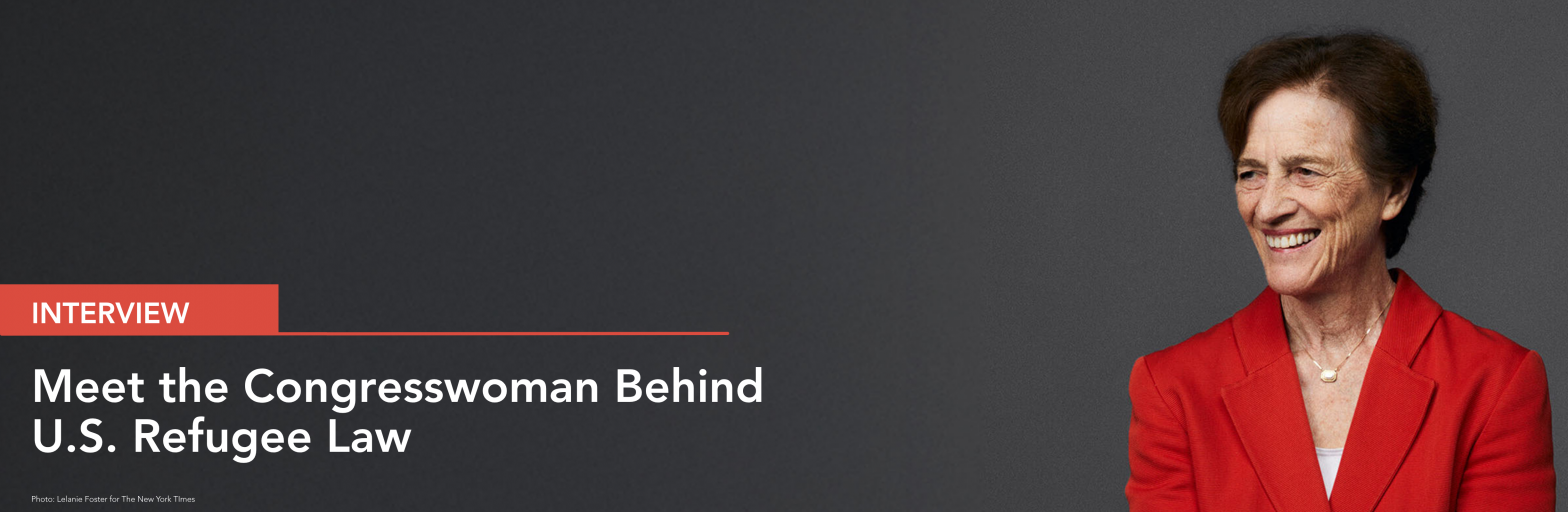
As Chair of the House Judiciary Subcommittee on Immigration, Refugees, and International Law, Congresswoman Elizabeth Holtzman steered the 1980 Refugee...
READ FULL STORY